Piazza del Campidoglio
M: Son of the CenturyPiazza del Campidoglio is presented as a civic gathering place whose significance in the narrative comes into focus on May 6, 1919, when Gabriele D’Annunzio addresses a vast crowd from the balcony of Rome’s city hall. Below him, the equestrian monument to Marcus Aurelius anchors a carefully composed public scene; above the crowd, a tricolor associated with a fallen soldier makes Italy’s disputed postwar victory visible. The piazza becomes more than a backdrop: it is where territorial grievance, remembrance of the war dead, and a leader’s authority are brought together before a mass audience.
Setting and Civic Stage
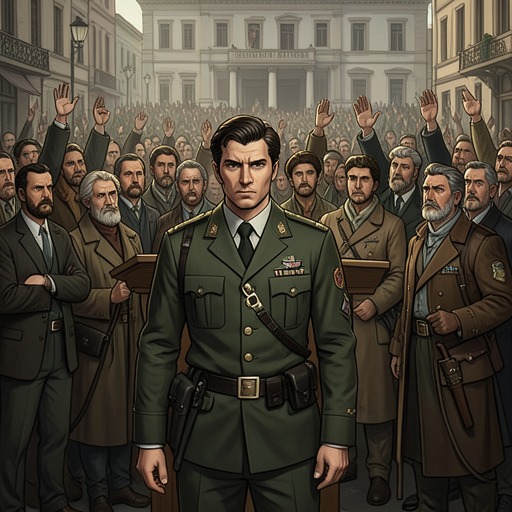
The crowd assembles in Piazza del Campidoglio around the equestrian statue of Marcus Aurelius, waiting for D’Annunzio to appear on the city-hall balcony. The gathering is immense, described as tens of thousands, including about twenty thousand young men. Many are veterans of the Great War. The narrative emphasizes the contrast between their physically intact appearance and the sense of injury D’Annunzio has taught them to feel through the idea of a “mutilated victory.” The piazza’s civic setting makes this transformation public: the audience gathers not in a private meeting or a military encampment, but in a prominent Roman square, facing the representative architecture of the city.
D’Annunzio’s position above the crowd gives the address a distinct spatial arrangement. The audience looks upward toward the balcony, while the equestrian monument supplies a second, monumental figure within the scene. The stillness of the listeners and the elevated speaker organize the gathering around the act of watching and hearing. In this arrangement, the piazza serves as both a place of assembly and a stage on which political identification is performed: the crowd’s shared attention connects its members to the speaker and to the national cause he articulates.
The Address and the Territorial Crisis
The speech takes place against the fallout from the Paris Peace Conference. On April 23, Woodrow Wilson publicly rejected Italy’s claims to Dalmatia and Fiume; on April 24, Prime Minister Vittorio Orlando and foreign minister Sidney Sonnino walked out of the conference. After fifteen days, they returned to Paris. The narrative describes the walkout and return as a public humiliation that deepened the sense that Italy’s wartime sacrifices had been inadequately rewarded. By May 6, that disappointment had spread beyond nationalist circles: the piazza’s crowd encounters the territorial dispute as a shared national injury.
D’Annunzio makes that injury the organizing idea of his appearance. He begins by referring to May 5 and to two remembered departures associated with Garibaldi and Napoleon, then proceeds in an elevated, allusive style. The crowd does not necessarily follow every learned reference, but it responds to the address’s cadence and solemnity. The setting thus joins political argument to public performance. Rather than presenting the territorial question only as a diplomatic disagreement, the speech turns it into a test of national honor, with the assembled listeners positioned as witnesses to an unfinished claim.
Randaccio’s Flag and Public Mourning
The scene’s central object is a large tricolor spread over the balcony railing. It is associated with infantry captain Giovanni Randaccio, D’Annunzio’s close friend, who died during an assault in the tenth battle of the Isonzo. D’Annunzio touches the flag and identifies it with the moment’s national purpose. He recalls that it had served as a pillow for the dying soldier, connecting the emblem of Italy to a particular death rather than leaving it as an abstract patriotic symbol.
From the balcony, D’Annunzio calls for the flag to be draped in mourning until Fiume and Dalmatia are returned to Italy, and urges good Italians to do likewise. The piazza consequently becomes the point from which a collective gesture is proposed: mourning is not confined to the square or to the memory of Randaccio, but is extended as a public obligation tied to the territorial claims. In the narrative, the flag gathers together the war dead, the sacrifices of veterans, and the postwar dispute. Its place on the railing makes that connection visible to the crowd below, while the requested mourning gives the audience a shared form through which to express it.
Narrative Significance
Piazza del Campidoglio concentrates the narrative’s account of how disappointment after the war could be shaped into political spectacle. The crowd arrives already within a crisis of expectation; D’Annunzio supplies a language and an emblem through which that crisis can be understood as injury and remembered as a continuing cause. The square’s monuments and civic setting lend weight to the performance, while the flag and the balcony make its central relationship legible: a leader speaks from above, and a mass audience receives the national story as a public ritual.
The scene also marks a contrast between diplomatic events unfolding in Paris and their emotional interpretation in Rome. As Orlando and Sonnino return to negotiations, D’Annunzio appears in the Campidoglio and insists that the wound of the disputed settlement remain open in public memory. The piazza does not resolve the claims over Fiume and Dalmatia; it gives their unresolved status a setting, an emblem, and a collective audience. Its significance in the book rests on that conversion of political grievance into a visible ceremony of remembrance and commitment.